The map
The Types of Affirmations, in One Map
Affirmations aren't one thing. In practice, most people reach for one of six types — grounded, identity, gratitude, self-compassion, action-oriented, or future-oriented — depending on what the moment actually calls for.
Underneath those six, there's a deeper structure too: every affirmation also has a charge, a method, and a context, which is what the interactive map further down breaks apart. Your brain is already repeating statements about you until it accepts them as true — that part isn't optional. What's optional is the direction. If yours keep bouncing off, the reason is usually in context, not effort.
Six types you'll actually reach for
Less a taxonomy, more a toolkit — matched to the moment each one is built for.
Grounded / contextual— for a hard day
Meets you exactly where you already are, instead of asking you to leap somewhere you're not yet. If an affirmation assumes a mood or belief you don't currently have, that distance is usually why it isn't landing — more on that in why affirmations don't work.
"I don't have to have this figured out right now." "I've gotten through hard days before."
Identity— for self-trust
Names who you are, not just what you can currently do — closer to the value branch in the map below. Useful when you're trying to trust yourself again after a mistake or a stretch of self-doubt.
"I'm someone who follows through, even when it's inconvenient." "I trust myself to figure this out."
Gratitude— for perspective
Points at what's already true and already working, instead of what you're trying to become. A quieter type — usually more useful on ordinary days than hard ones.
"I have at least one person I can be honest with." "Something today went right, even if I have to look for it."
Self-compassion— for rest
Extends the patience you'd give a friend to yourself instead. Useful on the days you fell short of what you wanted, or the days you just need to stop.
"I'm allowed to rest without earning it first." "One hard day doesn't undo the progress I've made."
Action-oriented— for focus
Points at the next concrete step instead of a feeling you're supposed to have. Useful when you're stuck or procrastinating and need to start rather than feel ready.
"I only have to start the next five minutes." "I can do the next right thing without seeing the whole path."
Future-oriented— use carefully
Speaks from where you're headed rather than where you are — the type most likely to create the gap described above if the leap is too big. Tends to work best paired with something closer to the present.
"I'm building toward something, even on the days it isn't visible." "The direction I'm moving in matters more than today's pace."


tap any node to explore
These apply to any affirmation above
how you use them
Any affirmation above can be practiced any of these ways.
where they land
And each one meets you somewhere different.
Every branch, defined
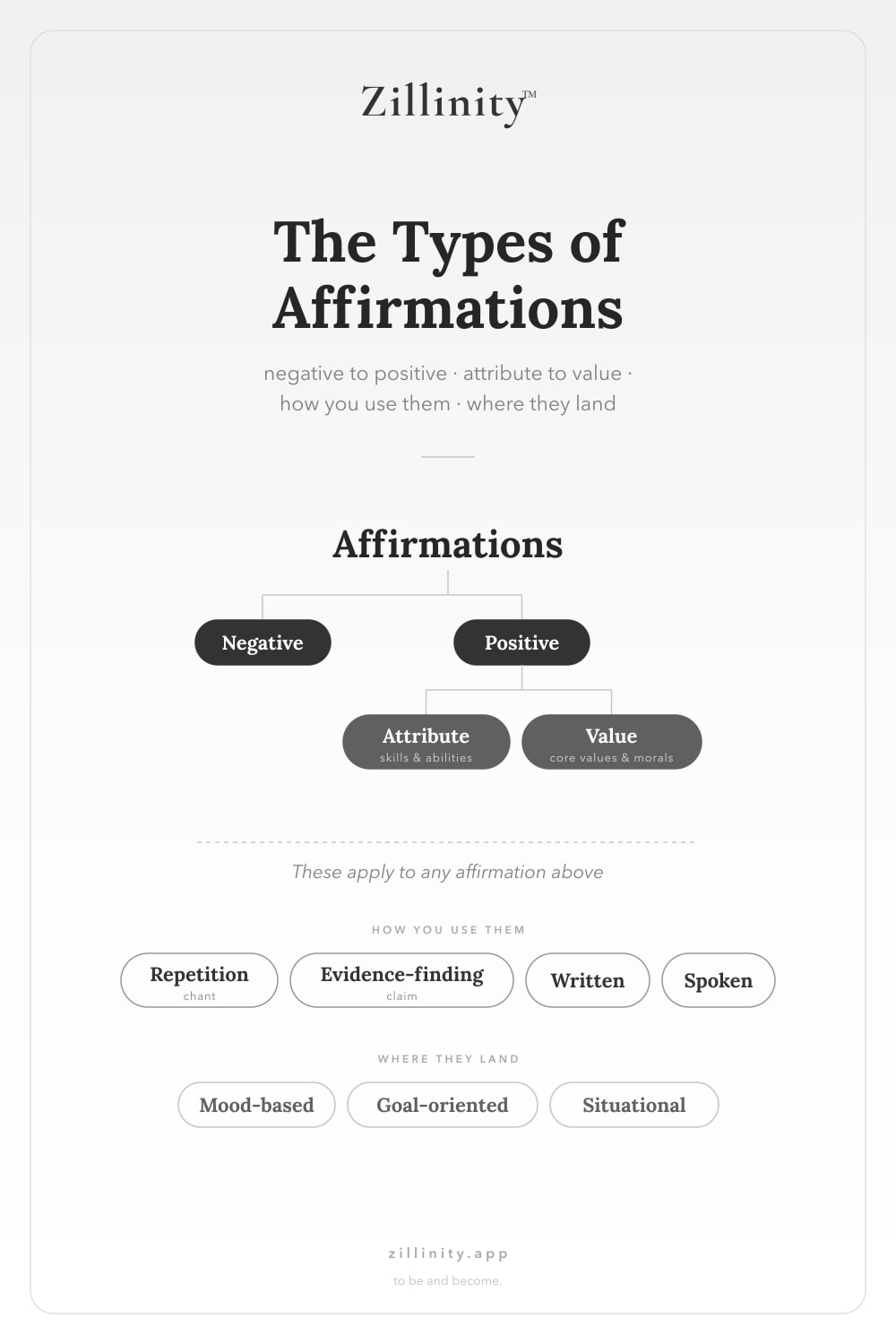
The same map, written out — every type of affirmation, and what each one is actually for.
by charge
- Negative
- The self-talk we’ve internalized from society, people close to us, and micro-projections absorbed over time. These are affirmations too — just ones we never consciously chose.
- Positive
- Intentionally chosen statements. When you decide to do affirmations on purpose, this is what you’re reaching for — redirecting what your brain is already doing.
what positive affirmations affirm
- Attribute— skills & abilities
- Affirm your skills and abilities — what you can do. “I am a quick learner.” Effective, though the brain sometimes argues back on these.
- Value— core values & morals
- Affirm who you are at your core — your morals and principles. Research shows value-based affirmations are harder for the brain to dispute, making them more effective.
how you use them
- Repetition— chant
- Saying or writing an affirmation repeatedly to strengthen the neural pathway. The more you walk the trail, the clearer it becomes.
- Evidence-finding— claim
- Finding past, present, and future proof that an affirmation is already true for you. Grounds the words in something real.
- Written
- Journaling or scripting affirmations by hand. The physical act of writing reinforces the neural connection.
- Spoken
- Saying affirmations out loud — mirror work, morning rituals, vocal repetition. Hearing your own voice say it changes something.
where they land
- Mood-based
- The affirmation that meets you where you are emotionally right now. No leap required.
- Goal-oriented
- Affirmations aligned with what you’re actively working toward. Pulls you forward.
- Situational
- Affirmations tailored to a specific moment — before a hard conversation, during a creative block, after a setback.
Questions about the types
What are the different types of affirmations?
In everyday use, most affirmations fall into six familiar types: grounded (meets a hard day head-on), identity, gratitude, self-compassion, action-oriented, and future-oriented — each suited to a different moment rather than a different person. Underneath that, every affirmation also sorts four more ways at once. By charge, it is negative or positive — the self-talk you absorbed without choosing it, versus the statements you pick on purpose. By what it affirms, positive ones split into attribute affirmations (your skills and abilities) and value affirmations (your morals and principles). By method, there is repetition, evidence-finding, written, and spoken. And by context, an affirmation can be mood-based, goal-oriented, or situational.
What is the difference between attribute and value affirmations?
An attribute affirmation names something you can do — "I am a quick learner." A value affirmation names something you are at your core — what you care about and stand for. The distinction matters because the brain can argue with an attribute claim by digging up counter-evidence, and it has a much harder time disputing a value. Research on self-affirmation theory finds value-based affirmations more durable for that reason.
Are negative affirmations a real type of affirmation?
Yes, and that is the uncomfortable part of the map. An affirmation is just a statement repeated until the brain accepts it as true, and that process runs whether or not you chose the statement. The critical self-talk absorbed from other people qualifies on the mechanics alone. Doing affirmations deliberately is not starting the process — it is redirecting one that is already running.
Which type of affirmation works best?
Value-based affirmations tend to hold up better than attribute-based ones, because they are harder for the mind to dispute. But the bigger factor is usually context, not category. An affirmation that sits far from what you can currently feel gets quietly rejected regardless of which branch it comes from. Mood-based affirmations tend to land first, because they require no leap.
What are the different ways to practice affirmations?
Four methods sit on this map. Repetition is saying or writing one over and over to strengthen the pathway. Evidence-finding is collecting past, present, and future proof that it is already true for you, which grounds the words in something real. Written means journaling or scripting by hand. Spoken means saying it out loud — mirror work, morning rituals, vocal repetition. They combine freely; most people end up using two or three.
Keep the map
Save the whole taxonomy to a board and come back to it when an affirmation isn't landing.
Save to PinterestWhere this goes next
- Context-aware affirmations — how Zillinity picks the last row of the map for you.
- Why affirmations aren't working — the distance problem, in full.
- Journaling — the written branch, with somewhere to put it.
- How a Zillinity space works — mood, space, session.